“We have Paleolithic emotions, medieval institutions and godlike technology.” – Edward O. Wilson
A genocide is happening, and the post about it got a hundred thousand likes. The post, depicting a starving child in torn clothes, standing in piles of rubble, got reshared fourty-eight thousand times. The caption says the child was brutally murdered. We click reshare, we write a comment the likes of “Poor soul”, “#FreePalestine” and “How did we let this happen?”, and we turn off our phones to continue our lives in privilege. That is precisely how we have allowed this to happen, how we have allowed images of unimaginable, inhumane horrors to become regular, how our reactions to the crumbling of humanity don’t evolve past social media stories and into change. We have allowed ourselves to become disentistized. The age of developing and growing social media has quietly, behind our backs, stumbled us into the new age of activism.
The name I have chosen for the individuals that practice this, the Bedrotting Activist, possesses a presumption that is inherently false – the word “activist” comes from the verb “active”, and I would argue that the act of the Bedrotting Activist is contrastingly innately passive. It is a type of activism that preserves all of the selfish, opportunistic reasons for the cause yet none of the altruistic, empathetic ones – it is an act of doing good for the praise, for the validation. It is, in a sense, a performance of activism, a caricature of caring.
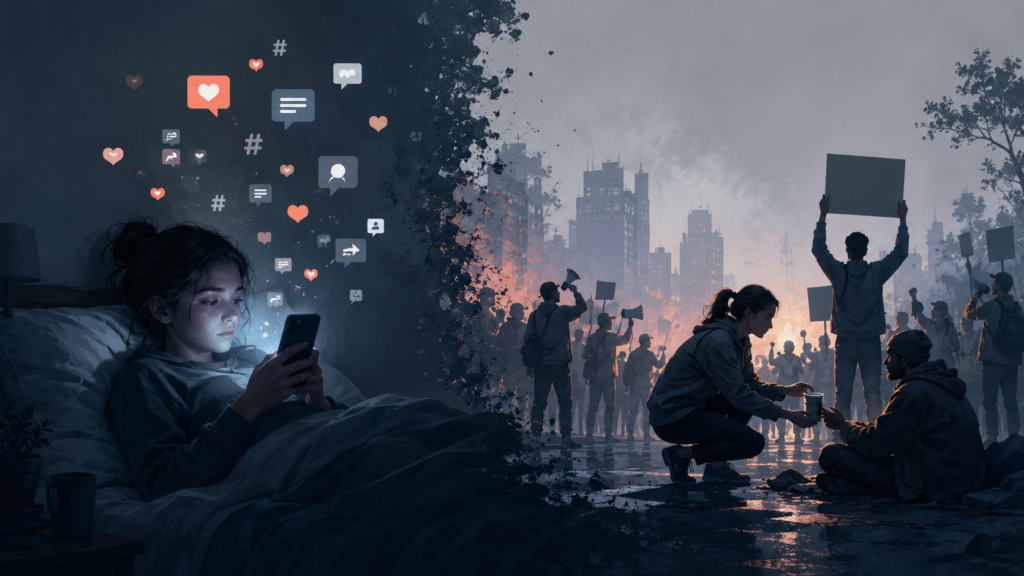
It is not within my belief that this new age of activism, or social media as a platform for it, is utterly bad; the power of sharing and spreading awareness is uncountable times greater on the internet than anywhere else, and it holds the ability to inform worldwide. Undeniably, social media has made millions aware of current socio-political events and exposed the side of humanity often left in the shadows. There lies the problem – because these types of media depicting human suffering and death have become normalized on these platforms, the wider audience has become less and less affected by it. Humans were never supposed to see such atrocities so often and so normally. The normalization of these images on the internet represents a detrimental contribution to the normalization of the events behind the picture, and only furthers the people away from empathy and social action. I recognize that is not the intended effect – yes, these topics need to be constantly talked about on as large of a scale as possible; yes, people should be uncomfortable with the amount of violence, sorrow and death globally. The problem arises when people become so desensitized that they are not uncomfortable.
Activism arises from a deep moral sense of injustice, anger, empathy, care and drive. It is an action derived from a strong strive for change, and the willingness to give a considerable amount of effort into the change. The adjective I have assigned in my characterization of this phenomenon is precisely placed to show the contrast between this new age of advocacy and what we as society are used to. “Bedrotting” , a term now popular on the very platforms I am scrutinizing, is defined as a description of somebody who spends a lot of time in bed, who is disengaged and unproductive. In other terms, “bedrotting activism” is lazy activism. It is the very minimum of effort that a person could give into fighting for a cause, which contradicts the point behind it; one cannot call themselves a pioneer for change and engagement if the amount and quality of effort they invest is only just enough to not be criticized.
The pressure of making a difference is especially prominent among the youth (who are the most active age group on the internet) in the search to prove that they are civilly engaged and knowledgeable about the state of the world. Very rarely will people outright say they couldn’t care less about a worldly injustice – it is, within the morality of humans, deeply embedded that we must care, that we must be empathetic towards the less fortunate. It is what makes us good, and it is in the human interest to be good. Although I strongly reject categorizing people as either good or bad, the predominantly good individuals do seem to do better in life: they are better liked, better known and therefore, better recognized. The expectation on a wider scale is to strive to be good. Even if one knows that, for example, they do not care about a particular global cause (which paints them as less good), they might act in a certain way to fulfil the societal expectation and get the benefits of being perceived, which poses the question: How many do actually care, not out of obligation to the socially acceptable, not out of personal interest and gain, but out of genuine responsibility to their morals and worldview?
These performative attempts at advocacy and campaigning are seen in every corner of ordinary life, and are exceptionally conspicuous in times of crisis. I have witnessed the rise of the Bedrotting Activist first-hand: during the mass Serbian university student protests against the government that marked 2025., many have stood on the side of the youth. Schools were shut for months, teachers and pupils protesting in solidarity. Nevertheless, many have done it not out of the genuine concern for our nation, but out of personal gain – a few acquaintances have consistently posted about the situation with hashtags of freedom, broken-hearted emojis and with a song written in the 90’s about a different time and different politics, yet when the time came for them to come to rallies, to support our professors, to actively contribute to the resistance movement, they were nowhere to be seen. It happened massively; people claimed they supported the fight, yet never put on their match gloves. A video showing the pointlessness of these claims went viral in April 2025 when, during the largest ever recorded protest in the Balkans took place, one woman was being interviewed live by one of the few independent news channels left. The interviewer informed her that many people were watching at home and rooting for the students on the streets, and she took the microphone and said: “I don’t want you to support me from your homes. I have nothing from you staying at home, watching me on television. I want to see you here, with me, in the streets, where we can cry together and fight together. I need you to fight with me.” The sharing and educating is also of foremost importance, as mentioned above, yet it means little if the talk isn’t backed up by actions.
Another possible explanation for the refusal of people to contribute is inconvenience. As talked about further in my upcoming piece “Treat People With Kindness – The Lost Art of Empathy”, it appears that nobody wants to even slightly inconvenience themselves for the overall wellbeing of others. That notion is only strengthened if they hold privilege in the given situation and are therefore less or not impacted. A consensus is that people tend to care less about issues they do not relate to, even though they are able to feel basic empathy for the victims. Like the lack of engagement during the Serbian protests, the same thing could be said about the world’s view on the situation in Gaza, Sudan, Ukraine and many others. Comfortable in their bubbles of privilege, many would rather watch the world burn from a screen than ever leave the warmth of their couch.
Of course, it is rather clear that not all actions of change are available to everyone equally. If there is truly nothing else you can do but share information and facts on social media, then I encourage you to do so, by all means. However, that is rarely the case – there is at all times something you could do. Whether that be donating money to the cause, volunteering, or a simple conversation that encourages dialogue and education, there is always an opportunity for change, no matter how large. The spreading of the word is powerful, but a small act of kindness is much more personally meaningful to the people impacted. The beauty and power of activism is in the doing: rather than sharing a post about the statistics of femicide, for example, donate clothes and food to the local women’s shelter. I guarantee an old sweater sitting in the back of your closet and a jar of jam will bring forth more change than a story on Instagram.
In a world such as ours, it is easy to get sucked up in the anxiety of all that is happening and feel overwhelmed with the amount of advocacy and civil engagement to be done. It may seem like no amount of engagement is ever enough, but even a small change is still a step forward in the right direction. To be truthful, the only thing separating the Bedrotting Activist from, say, giants of advocacy like the inspiring Greta Thunberg, is that the real activists aren’t afraid to leave their beds and comfort. Not everyone can be as influential as the greats, and it is not expected nor possible due to time constraints for the masses to do the absolute maximum and devote all their effort into the cause, but as a society we, as well, must never let the new age of activism overtake to the point where not a single individual exceeds the bare minimum. The social, political, cultural and ecological future of the world cannot be looked at as a test which one only needs to pass to ensure their standing as “good” in society, but rather a collective goal that can only be if it is cradled and nurtured by all in the present.