Albania’s population decline is already being driven by a combination of emigration, low fertility and population ageing. EU membership may initially intensify the movement of young Albanians by widening access to European labour markets, but it could also create the economic and institutional conditions needed to turn migration from a one-way loss into a more circular process of mobility, return and knowledge transfer. The decisive question is therefore not whether young Albanians will move, but whether Albania can become a country to which they have strong reasons to return.
A country becoming smaller!
Few demographic questions are as consequential for Albania as the future of its young people. For decades, emigration has been part of the country’s social and economic reality, but the scale of the challenge has become harder to ignore. According to the Institute of Statistics (INSTAT), Albania had 2,335,930 residents on 1 January 2026, a decline of 1.16% compared with the previous year. The decline is not simply a statistical fluctuation: it reflects a structural demographic problem in which migration interacts with falling fertility and an ageing population.
INSTAT’s population data show how closely these forces are connected. In 2024, Albania recorded a positive natural increase of 1,208 people, but net migration was negative by 28,836. In other words, more people left the country than entered it by a margin far larger than the natural increase could compensate for. INSTAT has also documented a long-term decline in births, while its analysis of the 2023 Census notes that low fertility, increased life expectancy and the emigration of people of reproductive age have narrowed the base of the population pyramid.
The international dimension is equally striking. The World Bank’s 2024 Albania Country Report on international mobility estimates that more than 1.2 million Albanian citizens have migrated abroad, equivalent to more than 44% of the country’s current population as presented in the report. Although migration is not exclusively a youth phenomenon, young and working-age people are particularly important to Albania’s future because their departure affects not only today’s labour supply but also tomorrow’s families, tax base, entrepreneurship and human capital.
For young Albanians, the decision to leave is rarely reducible to one factor. Wage differences matter, but so do career prospects, the quality of public services, education, professional development, perceptions of meritocracy and the possibility of building a predictable future. This is why the term ‘brain drain’ is useful, but incomplete. The issue is not simply that educated people leave. It is that a country can lose precisely the skills, initiative and productive years it needs to transform its economy.
What could EU membership change?
Albania is not yet an EU member, and accession remains conditional on completing negotiations, implementing reforms and securing final agreement and ratification. Nevertheless, the accession process has advanced substantially.
The most obvious effect of membership would be greater labour mobility. Free movement of workers is a fundamental EU principle: EU citizens can generally look for employment in another Member State, work there without a work permit and receive equal treatment in employment and related social and tax matters. However, the exact arrangements for a future Albanian accession would be determined by the accession treaty, which can contain transitional measures. It would therefore be inaccurate to assume that full labour-market access would necessarily begin everywhere on the first day of membership.
In the short term, EU membership could increase emigration. This may sound paradoxical, but it is economically plausible. If a young Albanian can access a much larger labour market, compare salaries more easily and have greater legal security when living abroad, the incentive to move may rise. Countries that enter a larger economic area can initially experience outward mobility before convergence in wages, productivity and employment opportunities reduces the pressure to leave.
Yet the same integration process could eventually create the opposite effect. EU accession can support investment, competition, institutional reform, research cooperation, skills development and access to larger markets. Albania is already receiving support through the EU Growth Plan for the Western Balkans, including funding linked to business competitiveness, innovation, education and digitalisation. If these reforms translate into better jobs and higher productivity at home, the economic gap that drives migration can gradually narrow.
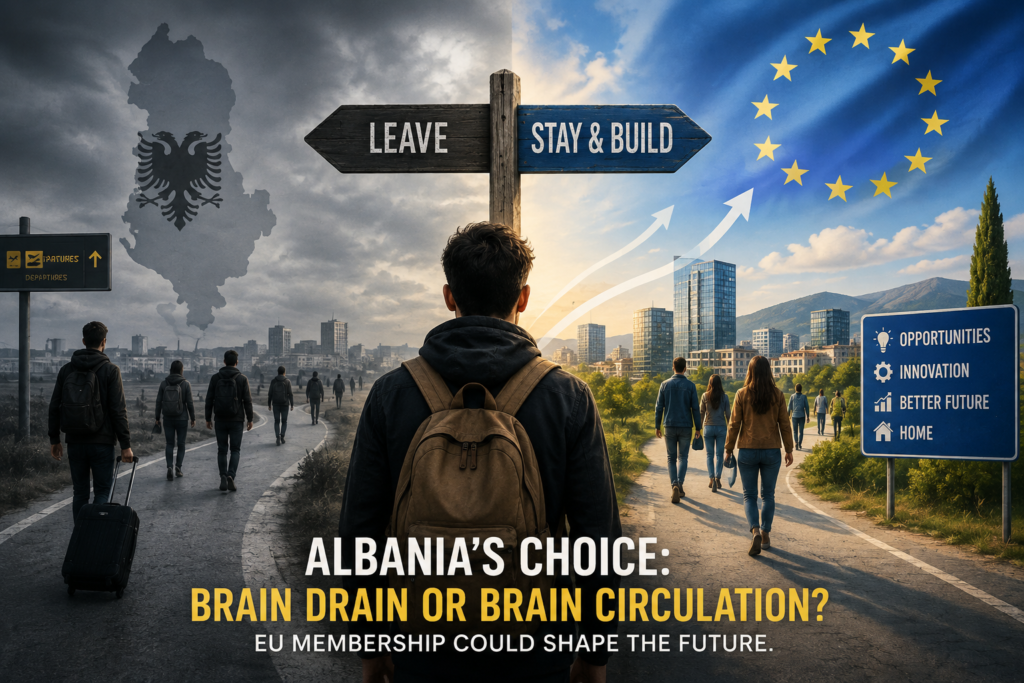
From brain drain to brain circulation
The most productive way to approach Albania’s demographic future is therefore to move beyond the simplistic idea that migration itself is the problem. Mobility is a normal part of modern European life, and trying to prevent young people from leaving would neither be realistic nor desirable. The policy objective should instead be to make departure a choice rather than an economic necessity, while creating credible pathways for return, investment and knowledge exchange.
This is where the Albanian diaspora can become an asset. The World Bank argues that migration, when properly managed, can generate investment, knowledge transfers and eventually ‘brain gain’ through the return of skilled migrants. For Albania, that means building institutions capable of maintaining meaningful connections with citizens abroad: recognising qualifications acquired overseas, supporting diaspora entrepreneurship, facilitating investment, creating research and professional networks, and making return less bureaucratically costly.
Young people who remain in Albania also need a stronger reason to stay. This does not mean asking them to sacrifice mobility for patriotism. It means improving the conditions under which staying becomes a rational and attractive decision: competitive wages, transparent recruitment, quality education, opportunities in technology and research, stronger local economies, reliable public services and confidence that professional effort will be rewarded.
So, will Albania’s population continue to fall? In the near term, the evidence suggests that continued demographic pressure is likely. The population has already declined and the age structure has been reshaped by low fertility and emigration. EU membership could intensify outward mobility at first, particularly among ambitious young people seeking higher salaries and broader professional opportunities. But that is not the end of the story.
Albania’s European future should be measured not only by how many people leave, but by whether the country becomes capable of attracting people back. The choice is not between an Albania that keeps its young people inside its borders and an Albania that loses them to Europe. The more realistic goal is an Albania that is fully connected to Europe while remaining capable of offering young people compelling reasons to return, invest, work and build families at home. In that sense, the country’s demographic future will depend less on stopping the movement of its young people than on giving them something worth coming back to.
Sources:
Instat- Population of Albania on 1st January 2026
Instat- Population
World Bank – International Mobility as a Development Strategy: Albania Country Report (2024)
European Commission – Reform and Growth Facility for Albania
European Commission – Albania: Enlargement and Eastern Neighbourhood