The MEDIActive Youth Network (MAYnet) enters 2026 with a clear and structured work plan aimed at strengthening media literacy, critical thinking, and youth engagement across Europe. Building on previous cooperation and shared experience among partner organisations, the Work Plan sets out a series of interconnected activities designed to respond to the growing challenges of misinformation, digital manipulation, and the evolving role of media in democratic societies.
At a time when young people are increasingly exposed to complex information environments – shaped by algorithms, platform dynamics, and artificial intelligence – the need for structured, high-quality media literacy education is more evident than ever. The MAYnet Work Plan 2026 addresses this need through a combination of education, content production, network development, and advocacy.
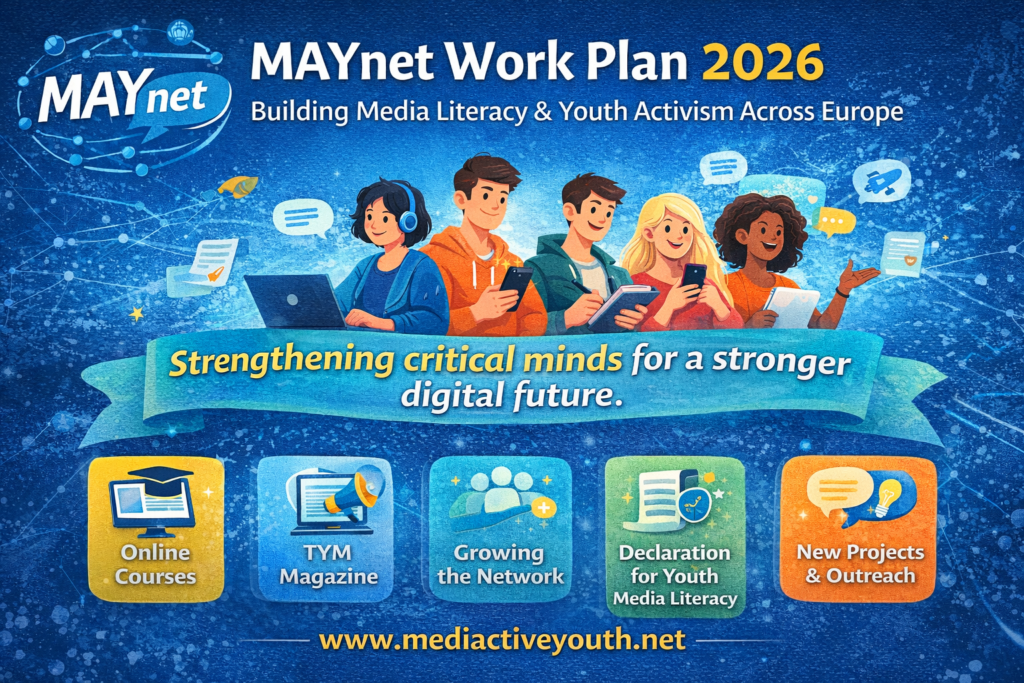
A central component of the Work Plan is the implementation of two mentored online courses: Introduction to Media Literacy and Critical Thinking and Advanced Media Literacy. These courses are designed not only to provide theoretical knowledge, but also to develop practical skills among youth activists. Through a combination of lectures, discussions, and mentoring, participants will be supported in understanding media systems, analysing information, and producing their own content.
Importantly, the educational component is closely linked with content creation. Participants of the courses will contribute to the Transnational Youth Magazine (TYM), where they will publish articles reflecting on relevant social, political, and media-related topics. In this way, the Work Plan promotes not only learning, but also the active participation of young people in shaping public discourse.
Another key element of the Work Plan is the further development of the Network itself. MAYnet aims to expand its membership by engaging new youth organisations across Europe, thereby increasing its geographical reach and impact. Strengthening cooperation among existing members, while simultaneously opening space for new actors, is seen as essential for ensuring the sustainability of the Network.
In parallel, the Work Plan foresees the development of a Declaration on Youth Media Literacy. This initiative is intended as a joint advocacy tool that will highlight the importance of media literacy and critical thinking in the current socio-political context, marked by the rise of misinformation, polarisation, and challenges to democratic values. By encouraging organisations to endorse the Declaration, MAYnet seeks to build a broader coalition of stakeholders committed to these principles.
The Work Plan also includes the preparation of new project proposals in the field of media literacy, with a particular focus on the implications of artificial intelligence. This reflects an awareness that the digital environment is rapidly changing and that youth organisations must continuously adapt their approaches and tools.
Communication, dissemination, and outreach activities form an important cross-cutting element of the Work Plan. Through social media, online platforms, and local initiatives, MAYnet will aim to reach a wide range of stakeholders, including youth organisations, educators, decision-makers, and young people themselves. These efforts are intended not only to promote the Network’s activities, but also to contribute to a broader public understanding of media literacy as a key competence in contemporary society.
Overall, the MAYnet Work Plan 2026 represents a comprehensive approach to youth media literacy, combining education, practice, cooperation, and advocacy. By placing young people at the centre of its activities, the Network continues to support their role not only as consumers of information, but as active and responsible participants in the digital public sphere.
Follow us at: https://www.facebook.com/profile.php?id=100082571300101