Screens are everywhere. They rest in pockets, glow on desks, illuminate bedrooms, and quietly shape how young people think, feel, and connect. For many adolescents and young adults, digital spaces are no longer separate from “real life”, they are simply life itself. Friendship, conflict, learning, creativity, identity formation, and even help-seeking increasingly unfold through digital platforms. This makes the relationship between technology and youth mental health one of the most urgent social and public health questions of our time.
Rather than treating technology as inherently harmful or universally beneficial, this article explores a more nuanced reality. It examines what we currently know about digital environments and mental health, identifies key risks and opportunities, and highlights initiatives that are already attempting to make the digital world safer and more supportive for young people.
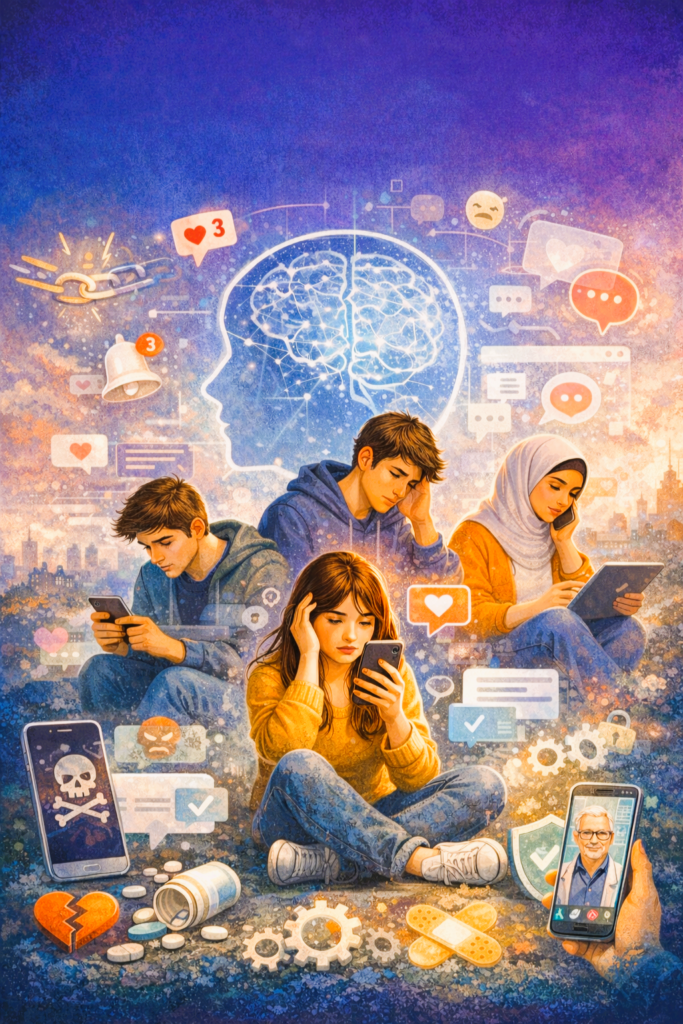
A generation under pressure and under observation
Across many countries, mental health difficulties among young people have become alarmingly common. Large-scale public health assessments indicate that roughly one in five children and adolescents experience a diagnosable mental health condition, with anxiety and depression appearing most frequently. This prevalence is not confined to one region or culture but reflects a broader global pattern that has drawn increasing attention from policymakers, educators, and clinicians. The growing concern around these trends is clearly articulated in discussions about adolescent mental health and digital habits, where public health institutions emphasize the need for coordinated responses rather than fragmented interventions.
At the same time, the rapid expansion of digital mental health tools has transformed how psychological support is delivered. Mobile applications, online therapy platforms, AI-assisted screening tools, and virtual peer-support communities promise greater accessibility and scalability. Yet, scholars analyzing this emerging field consistently warn that technological innovation comes with ethical dilemmas, particularly regarding privacy, data security, and the uneven quality of digital interventions. The tension between technological potential and ethical responsibility remains a central challenge in this domain.
The COVID-19 pandemic further intensified these dynamics. Almost overnight, schools, social interactions, and mental health services moved online. Many young people reported increased loneliness, stress, and uncertainty, yet relied heavily on digital platforms to maintain relationships and seek emotional support. This dual role of technology, as both a lifeline and a source of strain, has been widely examined in research on digital mental health challenges and solutions, underscoring the complexity of the issue.
Digital life: harm, help, and everything in between
Public debates often frame technology as either destructive or transformative. Its impact on mental health is far more complex and context dependent.
How digital environments can harm mental health
One of the most widely studied risks is social comparison. Platforms that prioritize visually curated images and idealized lifestyles can intensify feelings of inadequacy, particularly among adolescents who are already navigating identity formation and peer acceptance. Research examining youth mental health in the digital world consistently links heavy engagement with appearance-focused platforms to higher levels of body dissatisfaction, anxiety, and self-criticism.
Algorithmic amplification compounds this problem. By prioritizing emotionally charged or sensational content, recommendation systems can create “feedback loop” that deepen distress rather than alleviate it. A young person searching for self-harm content, for example, may be algorithmically directed toward increasingly harmful material — a phenomenon that has raised serious ethical and regulatory concerns.
Sleep disruption represents another critical issue. Late-night screen use suppresses melatonin production, fragments sleep and weakens emotional regulation. Poor sleep is strongly associated with heightened anxiety, irritability, and depressive symptoms. Public health analyses of teenagers, screens, and mental health emphasize that digital habits cannot be separated from broader wellbeing, particularly regarding sleep hygiene.
Additionally, not all digital mental health tools are evidence-based. Many apps marketed as therapeutic or wellness-oriented lack rigorous clinical evaluation, raising concerns about effectiveness, safety, and accountability. Scholars examining ethical challenges in digital mental health caution against treating technology as a quick fix without proper scientific validation and professional oversight.
How digital environments can support mental health
Despite these risks, digital technologies also offer meaningful and, in some cases, life-changing benefits. Teletherapy has expanded access to mental health care for young people in rural areas, marginalized communities, or regions with limited mental health professionals. Online cognitive behavioural therapy (CBT) programs have demonstrated effectiveness for mild to moderate anxiety and depression, particularly when paired with some level of human guidance. Research on digital interventions in mental health consistently highlights that hybrid models; combining technology with clinician support, yield the most reliable outcomes.
Peer support communities can also play a vital role in reducing isolation. Many young people report feeling understood and less alone when connecting with others who share similar struggles. For marginalized groups, such as LGBTQ+ adolescents, online spaces can provide crucial affirmation and belonging that may be absent in their offline environments.
Furthermore, data-driven tools can assist clinicians by tracking mood patterns over time, enabling earlier detection of mental health deterioration. However, the success of these tools depends on transparent data practices, informed consent, and ethical safeguards. Studies on digital mental health governance stress that trust is essential for meaningful adoption.
Why ‘’just reduce screen time’’ is not enough
Public discourse often simplifies the issue by suggesting that young people should spend less time online. While excessive screen use can indeed be harmful, this blanket recommendation overlooks the complexity of digital engagement.
Not all screen time is equal. Passive scrolling differs from active learning. Doom-scrolling differs from structured therapy apps. Social comparison differs from supportive peer connection. Consequently, experts increasingly advocate for a qualitative approach that focuses on how and why young people use technology rather than simply measuring hours spent online.
Digital tools are now integral to education, employment, and social participation. Advising young people to drastically reduce screen time is neither realistic nor necessarily beneficial. Instead, the goal should be healthy integration, fostering mindful, balanced, and purposeful digital use.
Existing initiatives: what is already being done
Several promising strategies have emerged at the intersection of technology, psychology, and policy.
1. Hybrid mental health care: technology + human support
The most effective digital interventions combine automated tools with professional guidance. Online CBT programs that include periodic check-ins from therapists show stronger outcomes than fully automated apps. This “human in the loop” model balances scalability with clinical safety and personal connection, a conclusion consistently supported by research on digital mental health interventions.
2. Ethical data governance and transparency
As mental health platforms collect sensitive personal data, strict privacy standards are essential. Scholars emphasize the importance of informed consent, data minimization, and clear communication about how information is used. Without transparency and trust, young people may avoid seeking help altogether, a key theme in discussions of ethical digital mental health systems.
3. Digital literacy education
Many schools now incorporate digital wellbeing curricula, teaching students how to recognize misinformation, manage online pressures, and establish healthy boundaries. Special emphasis is placed on sleep hygiene, critical thinking, and emotional regulation. Evidence from collaborators and WHOanalysis suggests that practical, skills-based education is more effective than fear-based messaging.
4. Youth co-creation of mental health policies
A growing movement in Europe encourages young people to actively participate in designing mental health initiatives rather than being passive recipients of care. This participatory approach increases relevance, trust, and effectiveness. Examples of youth co-creation in mental health policy demonstrate that involving young voices leads to more responsive and inclusive systems.
Cultural and generational dimensions
Digital mental health is not experienced uniformly across cultures. In some societies, online spaces offer rare opportunities for self-expression and support. In others, digital surveillance and stigma surrounding mental illness create additional barriers. In highly restrictive political contexts, young people may rely on encrypted platforms to discuss mental health anonymously. Meanwhile, in Western countries, debates focus more on corporate responsibility, algorithmic accountability, and platform design.
These differences highlight the need for context-sensitive approaches rather than “one size fits all” solutions.
The ‘’brain rot’’ debate and digital consumption
Recent cultural critiques have drawn attention to the phenomenon of young people intentionally consuming low-quality, repetitive content; often referred to as “brain rot”. Some commentators interpret this as evidence of declining attention spans, while others argue that it reflects deeper anxieties about academic pressure, economic uncertainty, and social comparison. Discussions in Psyche about TikTok and youth behaviour suggest that such content can function as a coping mechanism rather than mere distraction.
Similarly, Jonathan Haidt’s book; The Anxious Generation, widely reviewed in mainstream media, argues that smartphones and social media have fundamentally reshaped childhood, potentially contributing to rising rates of anxiety and depression. These debates, covered extensively in The Guardian’s analysis of Haidt’s work, underscore the need for careful, evidence-based discussion rather than moral panic.
Policy implications: what needs to change
Moving forward, several key actions are necessary:
- Stronger regulation of social media algorithms that amplify harmful content.
- Clear standards for digital mental health apps to ensure safety and effectiveness.
- Greater investment in long-term research evaluating digital interventions.
- Closer collaboration between governments, educators, clinicians, and tech companies.
- Systematic inclusion of youth voices in policy development and platform design.
These priorities are echoed in recent analyses of the youth mental health crisis and potential solutions, which call for integrated, multi-sectoral approaches.
Conclusion: shaping a healthier digital future
The digital age is not a temporary phase; it is the landscape in which today’s youth are growing up. The goal is not to eliminate technology from their lives but to shape it in ways that protect and promote mental wellbeing.
This requires building safer platforms, improving digital literacy, expanding access to evidence-based care, and fostering environments where young people feel heard rather than monitored.
If society succeeds in aligning technological innovation with ethical responsibility, digital tools can become powerful allies rather than silent stressors. And if we listen carefully to young people themselves, they will guide us toward solutions that are not only effective but genuinely meaningful.