Living in an Age of Endless Information
For most of human history, accessing information required effort. People waited for newspapers, watched scheduled television broadcasts, or listened to the radio. Today, information arrives constantly. We wake up to notifications, scroll through social media feeds during breaks, watch videos during lunch, and exchange links with friends throughout the day.
This unprecedented access to information has brought many benefits. Young people can learn new skills, follow world events, connect with communities across the globe, and access educational resources that previous generations could only dream of. However, there is also a downside: not all information is accurate.
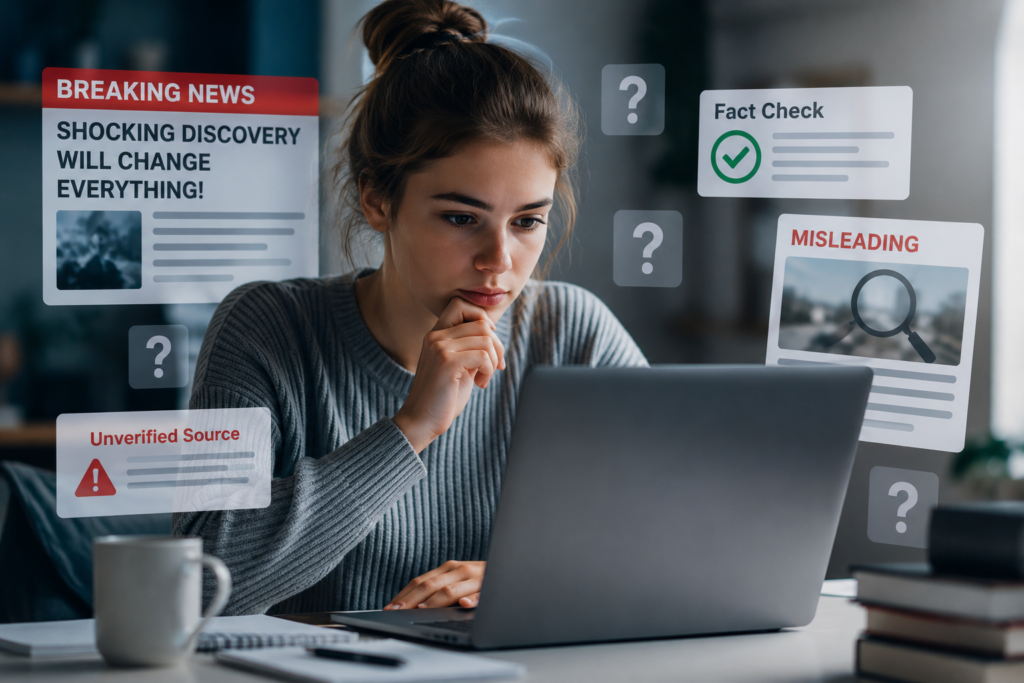
Fake news, misinformation, manipulated images, misleading headlines, and out-of-context videos have become common features of the digital environment. For young people who spend a significant portion of their lives online, learning how to distinguish reliable information from misleading content is becoming one of the most important skills of the modern age.
The challenge is not simply that false information exists. False information has always existed. The real challenge is that social media allows inaccurate information to spread faster and farther than ever before. A misleading post can reach thousands of people within hours and millions within days. By the time fact-checkers verify the information, many people may have already accepted it as true.
This reality raises an important question: how can young people navigate an online world where anyone can publish information and where appearances can be deceiving?
Why Fake News Spreads So Easily
One reason fake news is so successful is that it often appeals directly to emotions. People are naturally more likely to share content that makes them angry, shocked, excited, or afraid. Emotional reactions can sometimes override critical thinking.
According to FactCheck.org, misinformation often spreads because people share content before verifying its accuracy. In many cases, users react to a headline without reading the entire article or checking whether the claim is supported by evidence. As a result, inaccurate information can circulate widely even when the facts are readily available elsewhere.
Young people are particularly exposed to this challenge because social media platforms have become a primary source of information. News stories compete for attention alongside entertainment videos, memes, advertisements, and personal updates. In such a fast-moving environment, it is easy to prioritize speed over accuracy.
Another important factor is appearance. Many people assume that a professional-looking website must be trustworthy. However, a convincing design, a polished logo, or an impressive domain name do not guarantee credibility. FactCheck.org’s guide on spotting fake news emphasizes that readers should evaluate the source itself rather than relying on appearances alone.
This is where media literacy becomes essential.
Media literacy refers to the ability to access, analyze, evaluate, and critically engage with information from different forms of media. It encourages people to ask questions about the content they consume instead of accepting everything at face value.
The News Literacy Project, an organization dedicated to helping people become informed consumers of information, argues that media literacy is no longer a specialized skill. In today’s information environment, it is a practical necessity.
Fact-Checking: A Skill Every Young Person Should Develop
One of the most effective ways to combat misinformation is through fact-checking.
Fact-checking does not require professional training or advanced technical knowledge. In many cases, it simply involves taking a few extra minutes before believing or sharing a claim.
A useful starting point is asking basic questions:
- Who created this content?
- What evidence supports the claim?
- Is the information current?
- Can the claim be verified through multiple reliable sources?
- Does the source have a reputation for accuracy?
Teen Vogue’s guide to media literacy recommends that readers examine the source of information, look beyond sensational headlines, and compare information across multiple outlets before accepting it as true.
Another valuable technique is known as lateral reading. Instead of spending all your time examining a single article, you open additional tabs and investigate what other sources say about the organization, author, or claim. Professional fact-checkers frequently use this method because it allows them to quickly assess credibility.
For example, if a website claims that a major event has occurred but no established news organizations are reporting the same story, that should immediately raise questions. Similarly, if an article cites statistics without identifying where they came from, readers should be cautious.
Fact-checking also means paying attention to context. Sometimes information is technically true but presented in a misleading way. A photograph may be genuine but taken years earlier than claimed. A quote may be real but stripped of its original context. A statistic may be accurate but presented without the information needed to properly interpret it.
The goal of fact-checking is not to become suspicious of everything. Rather, it is to develop the habit of verifying important information before accepting it as fact.
Media Literacy and the Future of Youth Participation
Media literacy is about much more than avoiding fake news. It also influences how young people participate in society.
The opinions we form about politics, social issues, health, education, and global events are shaped by the information we consume. If that information is inaccurate, our understanding of the world may become distorted. This can affect public debate, trust in institutions, and even personal decision-making.
Young people are often described as digital natives because they have grown up surrounded by technology. Yet being comfortable with technology is not the same thing as being able to critically evaluate information. Knowing how to use social media is different from knowing how to recognize manipulation, misinformation, or bias.
For this reason, many educators and media experts argue that media literacy should be treated as a fundamental life skill. Just as schools teach reading, writing, and mathematics, they should also help students understand how information is created, distributed, and consumed.
Media literacy empowers individuals to become active participants rather than passive consumers. It encourages curiosity, critical thinking, and informed decision-making. These skills are valuable not only online but throughout everyday life.
In a world where information is available at the touch of a screen, the ability to evaluate that information may be more important than the ability to access it.
Conclusion
Fake news and misinformation are unlikely to disappear anytime soon. As technology continues to evolve, new challenges will emerge, from manipulated images and videos to increasingly sophisticated forms of online deception.
However, young people are not powerless in the face of these challenges.
By developing media literacy skills, learning basic fact-checking techniques, and approaching information with curiosity rather than blind acceptance, young people can make more informed decisions and contribute to a healthier information environment.
The next time a dramatic headline appears on your screen, take a moment before sharing it. Check the source. Look for evidence. Compare information with other reliable outlets.
A few minutes of verification can prevent the spread of misinformation and help ensure that facts, rather than falsehoods, guide our understanding of the world.
Sources
- FactCheck.org. “How to Spot Fake News.” https://www.factcheck.org/2016/11/how-to-spot-fake-news/
- FactCheck.org. “Misinformation.” https://www.factcheck.org/issue/misinformation/
- News Literacy Project. https://newslit.org/
- Teen Vogue. “Media Literacy 101: 5 Steps to Help You Avoid Fake News.” https://www.teenvogue.com/story/5-steps-to-improve-your-media-literacy