It has been recently proven that socio-emotional skills are important competencies to develop, positively impacting the personal and professional well-being of the youth who acquire them. However, most of the traditional education systems in Europe seem to ignore this fact. We spend years memorising dates or mathematical formulas, but nobody sits down to explain to us how to deal with a personal crisis, how to manage stress or, quite simply, how to understand what is going on inside us. More teachers should remember that students are people with complex inner lives, not machines designed to get good marks in an exam. As such, this subject shouldn’t be optional; it’s vital for every student and deserves to be a genuine priority in public schools, at the same level as academic subjects.
It’s important to understand that Socio and Emotional Education don’t refer only to feelings. According to the CASEL Framework, it is defined as follows: “the process through which all young people and adults acquire and apply the knowledge, skills and attitudes to develop healthy identities, manage emotions and achieve personal and collective goals, feel and show empathy for others, establish and maintain supportive relationships, and make responsible and considered decisions”. The CASEL Framework identifies 5 main areas of competencies to develop:
- Self-awareness
- Self-management
- Social awareness
- Relationship skills
- Responsible decision-making
The framework also takes into consideration the context in which youth grow up, and it’s possible to see that the classroom and school have an important role in it.
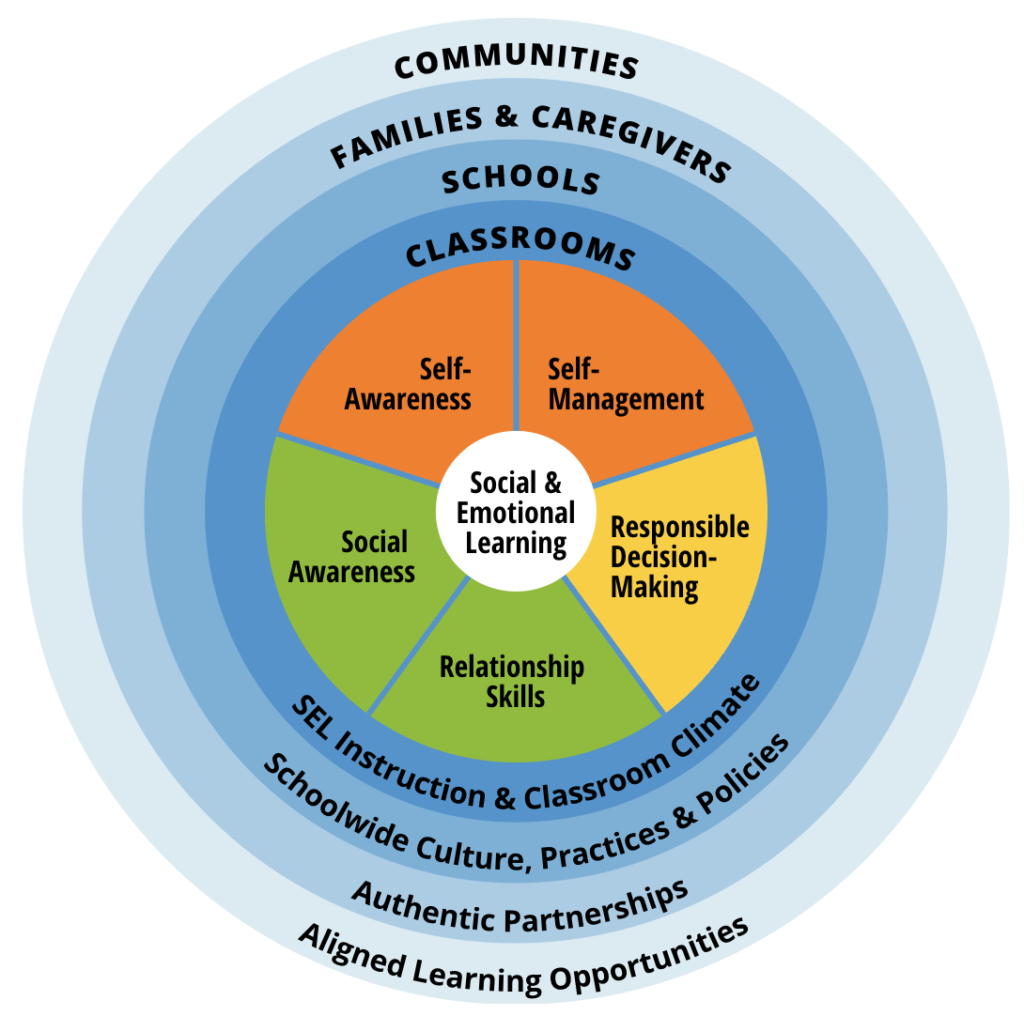
(Photo credit: Collaborative for Academic, Social, and Emotional Learning (CASEL))
Social and Emotional Learning provides youth with tools needed to effectively cope with a wide range of challenging real-world situations, allowing them to see benefits not only in their interpersonal relationships, but also in their academic performance and in their professional future, as stated in the OECD “Beyond Academic Learning” report. This is also confirmed by additional scientific literature and neuroscience that strongly support the idea that education on emotions also improves the results of traditional learning, making it more effective and increasing academic results scores. CASEL also tracked the progress of hundreds of thousands of pupils, and the findings are not negligible. “Pupils who take part in social-emotional learning programmes not only improve their attitudes, but also see their academic performance increase by an average of 11 percentile points compared with those who do not take part.”
This matter is so important that the European Commission has inserted Social and Emotional Learning among the strategies that every school should adopt to improve well-being in their environments. Some schools around Europe have already started to consider this topic seriously, and have started implementing it in their existing educational programmes, also supported by the EU program “Pathway to School Success”.
Those positive examples and methods explain clearly that social and emotional learning (SEL) can be integrated into the curriculum through a whole-school approach, involving not only teachers, but also pupils, parents and the wider community. We are already beginning to see projects where the teacher moves away from simply relaying information to creating a safe space for discussion. These programmes have shown that when the school environment is more pleasant, conflicts decrease and pupils finally feel that they belong to a community, not just a building full of classrooms.
The evidence supporting Social and Emotional Learning is clear, yet its implementation remains inconsistent across public education systems. Schools, educators and policymakers should start to recognise it as an essential component of the curriculum rather than an optional extracurricular activity. Investing in teacher training and embedding SEL into everyday school life would equip students with the skills needed to manage challenges, build healthy relationships and thrive both academically and personally.
Emotional education should not be viewed as an addition to traditional learning, but as a fundamental part of it. Preparing students for the future means developing not only their academic knowledge but also the socio-emotional competencies that enable them to navigate everyday life. Extensive research demonstrates that these two goals reinforce one another, making the integration of Social and Emotional Learning into public school curricula a necessary step towards a more effective and inclusive education system.
References
Beyond Academic Learning (EN). (n.d.-a). https://www.oecd.org/content/dam/oecd/en/publications/reports/2021/09/beyond-academic-learning_46cf4e15/92a11084-en.pdf
Durlak, J. A., Weissberg, R. P., Dymnicki, A. B., Taylor, R. D., & Schellinger, K. B. (2011). The impact of enhancing students’ social and emotional learning: A meta-analysis of school-based Universal interventions. Child Development, 82(1), 405–432. https://doi.org/10.1111/j.1467-8624.2010.01564.x
Indellicato, R. (2024). Educating on emotions for effective learning. Journal of Modern Science, 56(2), 24–43. https://doi.org/10.13166/ jms/189427
Pathways to school success – European Education Area. (n.d.-b). https://education.ec.europa.eu/education-levels/school-education/pathways-to-school-success
Social and emotional skills | OECD. (n.d.-c). https://www.oecd.org/en/topics/sub-issues/social-and-emotional-skills.html
Well-being at school – European Education Area. (n.d.-d). https://education.ec.europa.eu/education-levels/school-education/well-being-at-school
What is Sel? – casel. (n.d.-e). https://casel.org/fundamentals-of-sel/what-is-the-casel-framework/