“You’re wasting your time.”
If you are a young gamer, there is a good chance you have heard this phrase before. Parents, teachers, and even some media outlets have spent years warning about the dangers of video games. Gaming is often associated with addiction, isolation, poor academic performance, and unhealthy habits. The image of a teenager sitting alone in a dark room for hours has become one of the most common stereotypes in discussions about gaming.
At the same time, gaming has become one of the most popular forms of entertainment in the world. According to industry reports, billions of people play video games globally, with young people representing a significant portion of that community. If gaming is truly nothing more than a waste of time, why does it continue to attract so many people from different cultures, backgrounds, and age groups?
The debate surrounding gaming is not new. Critics argue that it distracts young people from education and real-life responsibilities. Supporters, however, believe that gaming can contribute to learning, creativity, communication, and personal development. While excessive gaming can certainly create problems, I believe the discussion often overlooks an important reality: when approached responsibly, gaming can be a powerful tool for learning and social development.
Looking Beyond the Stereotypes
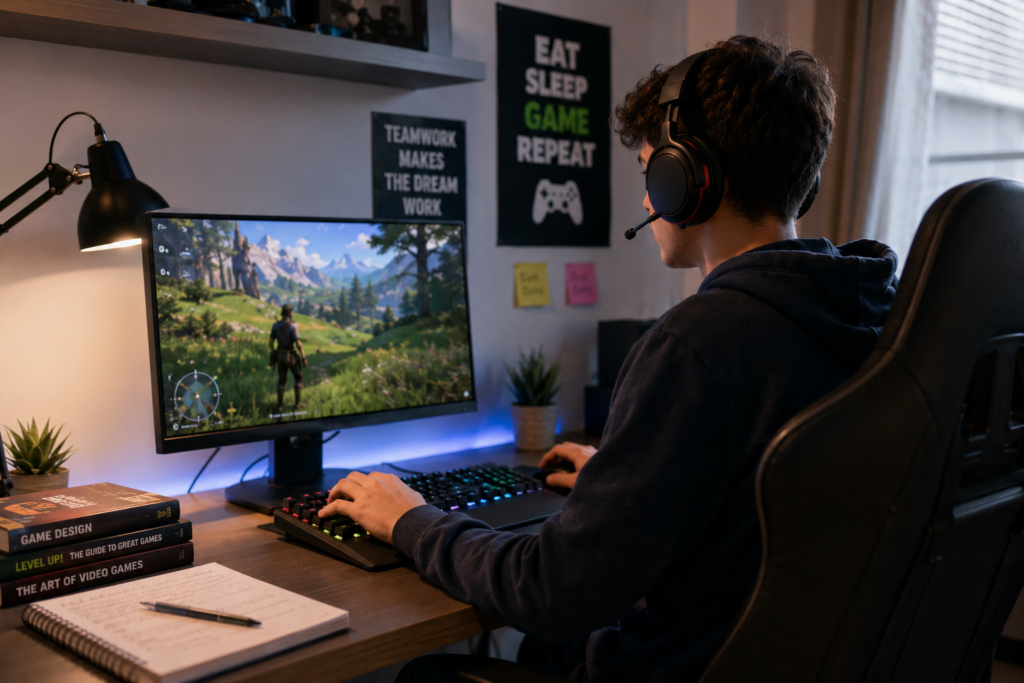
One of the biggest challenges in discussions about gaming is the persistence of outdated stereotypes. Video games are frequently treated as passive entertainment, similar to watching television. However, modern gaming is far more interactive and demanding.
Many games require players to solve problems, analyze situations, make decisions under pressure, and adapt to changing circumstances. Unlike passive forms of entertainment, games actively involve the player in the experience. Success often depends on critical thinking, creativity, and cooperation.
Consider a game such as Minecraft. While many people see it as a simple building game, it has been used in classrooms around the world to teach subjects ranging from mathematics to history. Players learn planning, resource management, design principles, and teamwork while creating virtual worlds.
Strategy games such as Civilization encourage players to think about economics, diplomacy, technological development, and long-term planning. Puzzle games challenge logical thinking and problem-solving skills. Even competitive multiplayer games require communication, coordination, and rapid decision-making.
The idea that gaming is inherently mindless simply does not reflect the complexity of many modern games.
Learning Without Realizing It
One of the most fascinating aspects of gaming is that learning often happens naturally. Unlike traditional educational environments, games rarely present learning as an obligation. Instead, players acquire skills because they want to overcome challenges and achieve goals.
Many young people improve their English language skills through gaming. As someone from Romania, I have personally experienced this phenomenon. A significant amount of the content in games, online communities, tutorials, and discussions is in English. For many players, gaming becomes an informal language-learning environment where vocabulary, reading comprehension, and communication skills improve over time.
Gaming also encourages persistence. Failure is a normal part of the gaming experience. Players may lose matches, fail missions, or make mistakes countless times before succeeding. Rather than viewing failure as something negative, games often teach players to treat setbacks as opportunities to improve.
This mindset can be valuable far beyond gaming. Learning how to adapt, practice, and persist after failure is an important life skill that can support academic and professional success.
The Social Side of Gaming
Perhaps the most misunderstood aspect of gaming is its social dimension.
Critics often argue that gaming isolates young people from society. While this may be true in some cases, it does not represent the experience of many players. Modern gaming is often deeply social.
Online multiplayer games allow people from different countries and cultures to communicate and collaborate. Players form teams, develop strategies, and work together toward shared objectives. In many games, success depends less on individual skill and more on effective teamwork.
Some of my own most memorable gaming experiences were not related to winning matches or completing objectives. They involved meeting people, having conversations, and building friendships with individuals I would never have encountered otherwise.
Gaming communities frequently bring together people with different backgrounds, perspectives, and experiences. These interactions can foster cultural understanding and help young people develop communication skills in diverse environments.
In a world that is becoming increasingly interconnected, opportunities to interact with people from different cultures should not be underestimated.
Gaming and Digital Skills
We live in a digital society where technological literacy is becoming increasingly important. Many of the skills developed through gaming overlap with competencies that are valuable in education and the workplace.
Gaming often introduces young people to concepts such as:
- Digital communication
- Online collaboration
- Information management
- Strategic thinking
- Problem-solving
- Adaptability
Beyond playing games, many young people become interested in content creation, graphic design, programming, video editing, or streaming. What begins as a hobby can eventually inspire educational and career opportunities.
The gaming industry itself has become one of the largest entertainment sectors in the world, creating opportunities for developers, designers, marketers, event organizers, journalists, and content creators.
While not every gamer will pursue a career related to gaming, the skills and interests developed through gaming can influence future professional paths.
The Importance of Balance
Supporting gaming does not mean ignoring its potential risks.
Like any activity, gaming can become problematic when it is excessive. Spending countless hours gaming while neglecting education, health, relationships, or responsibilities can have negative consequences. Concerns about addiction, sleep deprivation, and unhealthy habits should not be dismissed.
However, it is important to recognize that these problems are often related to excessive use rather than gaming itself.
The same principle applies to many other activities. Reading books, exercising, using social media, or working can all become harmful when taken to unhealthy extremes. The solution is not necessarily to eliminate the activity but to develop healthy habits and maintain balance.
Parents, educators, and young people should focus on responsible gaming rather than assuming that gaming is automatically harmful.
Changing the Conversation
One reason gaming continues to face criticism is that public discussions often focus primarily on negative stories. News headlines are more likely to highlight cases of gaming addiction than examples of learning, creativity, or community building.
As a result, the conversation becomes unbalanced.
This does not mean gaming is perfect or free from problems. Rather, it means that discussions about gaming should reflect both its challenges and its opportunities.
Young people deserve a more nuanced conversation—one that recognizes gaming as a complex activity with the potential to provide entertainment, education, social connection, and personal development.
Instead of asking whether gaming is good or bad, perhaps we should ask a different question: how can we help young people engage with gaming in healthy and productive ways?
Conclusion
The debate about gaming is unlikely to disappear anytime soon. As technology continues to evolve, video games will remain an important part of youth culture around the world.
While concerns about excessive gaming are valid, reducing gaming to a simple waste of time ignores many of its positive aspects. Games can promote problem-solving, communication, teamwork, creativity, language learning, and resilience. They can connect people across borders and provide opportunities for personal growth.
As someone who has spent years gaming, I believe the most important lesson is that gaming is ultimately a tool. Like any tool, its value depends on how it is used.
Rather than viewing gaming solely as a problem, we should recognize its potential as a space where young people learn, connect, and develop skills that can benefit them throughout their lives.
Sources
American Psychological Association (APA) – Video Games Research
Entertainment Software Association (ESA)